
 9 hours ago
10
9 hours ago
10
ARTICLE AD BOX
Watch: Trump compares attack on Iran to Pearl Harbor in meeting with Japanese PM
A key moment of Japanese Prime Minister Sanae Takaichi's official visit to the US was President Donald Trump's comment on a piece of shared history - Pearl Harbor.
Asked by a Japanese journalist why the US had not warned its allies it was going to strike Iran on 28 February, Trump referenced the 1941 Japanese attack on US soil.
"Who knows better about surprise than Japan? Why didn't you tell me about Pearl Harbor?," Trump said as the prime minister appeared to be opening her eyes wide and taking a deep breath.
The Pearl Harbor attack led to the US joining World War Two, after which the countries became close allies.
Trump's remark appeared to draw some laughter from journalists and others present in the room in the White House, while Takaichi's reaction seemed to reflect some of the unease that surrounds the issue.
Mineko Tokito, a senior reporter from Japanese newspaper Yomiuri Shimbun, was in the Oval Office at the time and said the PM's discomfort was "clear".
"Prime Minister Takaichi viscerally reacted, her eyes widening and her smile disappearing as she leaned back, drawing her hands in, clearly taken aback by the sudden mention of Pearl Harbor," she said.
Yuta Nakamura, a 33-year-old engineer, told Reuters news agency that Takaichi had been put in "a very difficult situation" and praised the PM for "avoiding upsetting Trump".
Tokio Washino, a retiree, said: "Given the historical context of Japan having done that, and with Donald Trump bringing it up as an example, it makes me feel a bit uneasy as a Japanese citizen."
What was the Pearl Harbor attack?
Japan and the US have been close allies since 1952 - but just 10 years earlier, a key decision by Japan sparked wide-ranging consequences for both countries and the rest of the world.
On the morning of 7 December 1941, while most of the world was already at war, Japan launched a surprise attack on the US naval base of Pearl Harbor in Hawaii, killing more than 2,335 US military personnel and 68 civilians.
The country officially declared war on the US.

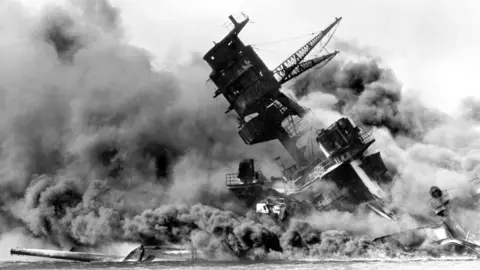 Pictures from History/Universal Images Group via Getty Images
More than a thousand US military servicemen died on the USS Arizona, pictured here shortly after the attack
The enmity between Japan and the US culminated in August 1945 when the US dropped two atomic bombs on Hiroshima and Nagasaki - the first and so far only use of nuclear weapons.
Hundreds of thousands of people were killed, with estimates ranging between 140,000 to 350,000 in Hiroshima and another 74,000 in Nagasaki.
Japan surrendered unconditionally just days later.
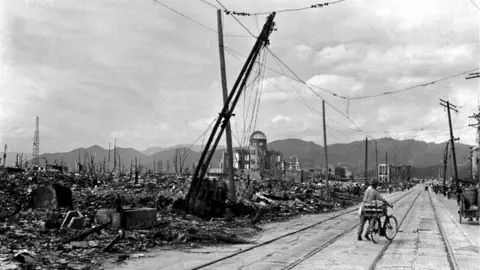 Pictures from History/Universal Images Group via Getty Images
Hundreds of thousands of people died as the world's first atomic bomb was dropped in Hiroshima on 6 August 1945
'Power of reconciliation'
Since then, leaders of both countries have tended not to dwell on the past in public, but focused on reconciliation.
In 2016, Japanese PM Shinzo Abe visited the US naval base at Pearl Harbor and a memorial in Arizona, offering "sincere and everlasting condolences" to the victims of Japan's attack.
Also in 2016, President Barack Obama became the first serving US president to visit Hiroshima, saying his visit was "a testament to how even the most painful divides can be bridged - how our two nations, former adversaries, cannot just become partners, but become the best of friends and the strongest of allies".
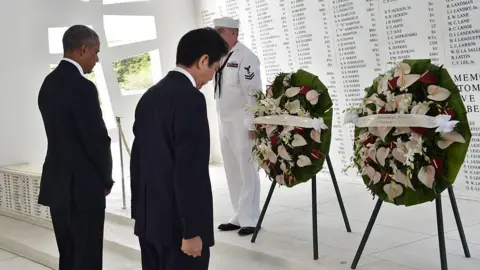 AFP via Getty Images
The 2016 visit was the first to the memorial site by leaders of both countries
Before arriving in Washington, Takaichi had feared the visit would be "difficult" - largely because of Japan's refusal to answer Trump's call to help reopen the Strait of Hormuz that Iran has closed in retaliation for the US-Israeli attacks.
In the event, the US president described them as "friends" and vaguely praised Tokyo for "really stepping up to the plate".
Before the talks at the White House, Japan joined six other countries pledging "to contribute to appropriate efforts to ensure safe passage through the Strait of Hormuz".
They have not specified how. Takaichi later told reporters she had briefed Trump on what support Japan could provide under its laws.
The blockage has led global oil prices to skyrocket, as about 20% of the world's oil travels through the passage.



 English (US) ·