
 2 hours ago
3
2 hours ago
3
ARTICLE AD BOX
Frank GardnerSecurity correspondent

 EPA
EPA
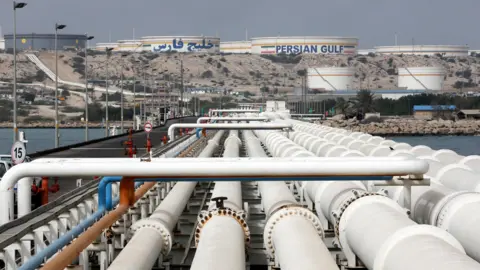
Around 90% of Iran's oil exports pass through Kharg Island
US President Donald Trump has indicated that he may send troops to seize control of Iran's key oil export terminal at Kharg Island in the northern Gulf. So what's behind this, how would it work and what are the risks?
Kharg Island has long been Iran's chief outlet for its oil exports. The island sits offshore with waters deep enough to load product onto tankers known as Very Large Crude Carriers (VLCCs), which can hold around two million barrels. Around 90% of Iran's oil exports pass through Kharg.
During the Iran-Iraq war in the 1980s it was frequently bombed by the Iraqi Air Force and on 13 March this year the US struck what it said were 90 military targets on the island. It however spared the oil infrastructure.
If the US does decide to invade Kharg Island then it would most likely be a temporary measure intended to put pressure on Iran by cutting off its fuel exports until it relinquished its chokehold on the Strait of Hormuz - one of the world's busiest oil shipping lanes - and conceded to Washington's demands.
Given the resilience and defiance of the Iranian regime it is highly questionable whether this would work.
The speaker of Iran's parliament, Mohammad Bagher Ghalibaf, has warned that his country's forces would "rain down fire" on any invading US forces. Iran is believed to have reinforced its defences on the island, including with surface-to-air missile batteries.
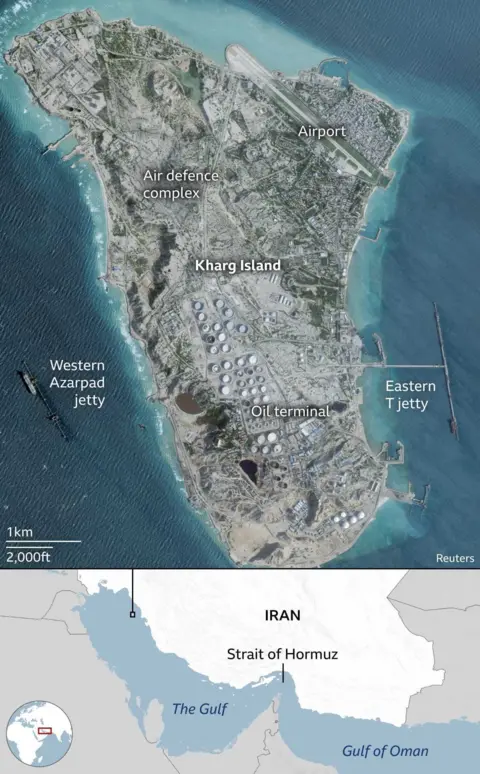
Iran has also accused the US of duplicity by proposing peace talks at the same time as dispatching troops to the region. These forces are made up of nearly 5,000 US Marines and around 2,000 paratroopers from the 82nd Airborne Division.
This has prompted widespread speculation that either or both could be used to seize and hold Kharg.
In theory, the paratroopers could make an airborne assault, probably at night, to seize key positions on this small island, which measures just 20 sq km (7.7 sq miles).
The US Marines would deploy from ships equipped with Osprey tilt-rotor aircraft and Landing Craft Air Cushioned (LCAC) for making amphibious landings. But first those ships would have to run the gauntlet of getting through the Iranian-controlled Strait of Hormuz and then sailing all the way up the Gulf past any number of hidden Iranian drone and missile launch sites.
Any landing, by air or sea, would expect to be met with anti-personnel mines and swarms of drones. Such is the awesome fighting power of these Marine Expeditionary Units (MEUs) that the US force would almost certainly prevail, but it could come at the expense of a severe number of casualties.
The US then has the problem of holding the ground, for an indeterminate period, while subject to bombardment from the Iranian mainland.
A comparable scenario would be Ukraine's Snake Island in the Black Sea, which Russia seized early on after its full-scale invasion in February 2022, only to be driven off it by constant harassing fire from the Ukrainian mainland.
Any lengthy US occupation of Iranian territory would also be unpopular back home in the US, including with some of President Trump's supporters who elected him partly on a promise to never again get embroiled in these sorts of conflicts.
Finally, it is worth noting that there has been so much noise made about a possible US ground assault on Kharg that it could be part of some deception plan.
There is no doubting its strategic value to Iran and the Islamic Revolutionary Guards Corps.
But there are other islands in the Gulf that could also be in America's sights. These include Larak Island, just offshore from the key port of Bandar Abbas, and sitting right on the Strait of Hormuz. Iran is currently making all tanker traffic pass by this island for checking and reportedly forcing vessels to pay $2m (£1.5m) to cross.
Then there is Qeshm, the largest island in the Gulf and 75 times bigger than Kharg, where Iran is suspected of housing underground missile and drone sites.
And there are three islands, Abu Musa and the Greater and Lesser Tunbs, whose ownership is disputed between Iran and the UAE but all are occupied by Iran.
Taken together with other Iranian islands, these Gulf islands form a protective shield for Iran that can threaten shipping and give it a geographical advantage that goes a long way to offset America's superior military power.
Then, there is the possibility that none of the above happens.
At the same time as sending more troops to the region and signalling the possibility of a ground operation, Trump said again on Monday that the US is in "serious discussions" with Iran, which could "end our military operations".
As we move into the fifth week of the war, Trump's public statements give little clue as to what his next big move will be.
But a "deal", which many suspect President Trump is more desperate for than the Iranians, will require bridging the currently enormous gap between the US and Iranian positions.





 English (US) ·