
 3 hours ago
3
3 hours ago
3
ARTICLE AD BOX
Jeremy BowenInternational editor
Mortuary videos shows violent government crackdown in Iran
How does an authoritarian regime die? As Ernest Hemingway famously said about going broke – gradually then suddenly.
The protesters in Iran and their supporters abroad were hoping that the Islamic regime in Tehran was at the suddenly stage. The signs are, if it is dying, it is still at gradual.
The last two weeks of unrest add up to a big crisis for the regime. Iranian anger and frustration have exploded into the streets before, but the latest explosion comes on top of all the military blows inflicted on Iran in the last two years by the US and Israel.
But more significant for hard-pressed Iranians struggling to feed their families has been the impact of sanctions.
In the latest blow for the Iranian economy, all the UN sanctions lifted under the now dead 2015 nuclear deal were reimposed by the UK, Germany and France in September. In 2025 food price inflation was more than 70%. The currency, the rial, reached a record low in December.
While the Iranian regime is under huge pressure, the evidence is that it's not about to die.
Crucially, the security forces remain loyal. Since the Islamic revolution in 1979 the Iranian authorities have spent time and money creating an elaborate and ruthless network of coercion and repression.
In the last two weeks, the regime's forces obeyed orders to shoot their fellow citizens in the streets. The result is that the demonstrations of the last few weeks have ended - as far as we can tell in a country whose rulers continue to impose a communications black out.
At the forefront of the suppression of protest is the Iranian Revolutionary Guards Corps (IRGC), the most important single organisation in the country.
It has the specific task of defending the ideology and system of government of the Islamic revolution of 1979, answering directly to the supreme leader, Ayatollah Ali Khamenei. The IRGC is estimated to have something like 150,000 men under arms, operating as a parallel force to Iran's conventional armed military. It is also a major player in the Iranian economy.
A potent mix of power, money, corruption and ideology means it has every reason to defend the system.

 West Asia News Agency via Reuters
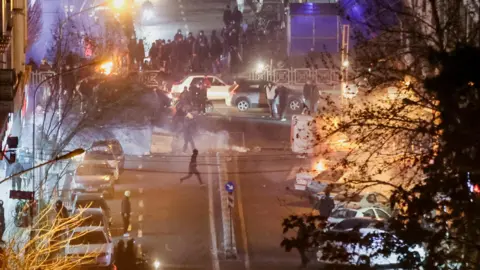
Iran's judiciary chief has vowed "swift and harsh" punishment for "rioters"
The IRGC has an auxiliary force, the Basij militia, a volunteer paramilitary organisation. It claims to have millions of members. Some western estimates put its active duty contingent in the hundreds of thousands, still a very substantial total. The Basij are at the sharp end of the regime's crackdowns against protesters.
I saw the IRGC and the Basij in action in Tehran in 2009, as they moved to suppress huge demonstrations that followed a disputed presidential election. Basij volunteers lined the streets armed with rubber truncheons and wooden clubs.
Behind them were uniformed men with automatic weapons. Motorcycle squads roared around Tehran's broad avenues, descending on groups trying to protest. In less than two weeks, protests that had choked the streets were reduced to small groups of students chanting slogans and setting fire to rubbish skips.
At dusk, people went to their balconies and rooftops to chant God is greatest, as their parents had against the Shah, until that petered out too.
The seeming resilience of the internal security forces does not mean that the supreme leader or his lieutenants can or will relax. US President Donald Trump is still threatening to take action. The millions of Iranians who want the fall of the regime must be seething with resentment and anger.
In Tehran, the government and the supreme leader appear to be looking for ways to release some of the pressure they are facing. Bellicose official rhetoric is mixed with an offer to resume negotiations with the US.
It is hard to see how the two sides can make a deal over Iran's nuclear plans and ballistic missile programme that have defeated earlier rounds of talks. But negotiations could buy time for Iran, especially if Trump can be convinced that a deal, however unlikely, is possible.
As part of his pressure campaign, Trump says that he will slap a 25% tariff on the goods of any country that does business with Iran. Again, it is hard to see how that might work. China buys most of Iran's oil.
Trump and China's President Xi Jinping agreed a truce in their trade war last autumn, with a summit due to be held in Beijing in April. The summit will deal the biggest issues facing the world's two superpowers. Would Trump want to jeopardise or disrupt the summit simply to keep up pressure on Iran?
In Tehran the biggest priority for the ageing Supreme Leader Ayatollah Khamenei is to preserve the Islamic Republic's system of rule. More eruptions of protest can expect a severe response.
An advantage for the regime is lack of coherent leadership among protesters. The eldest son of the Shah deposed by the revolution almost half a century ago has been trying to be the leader they lack. His appeal seems to be limited by his family's history and his close links with Israel.
One lesson that might worry the clerics and military men in Tehran comes from their erstwhile ally, former President Bashar al-Assad of Syria. He seemed to have won his war, and was being slowly rehabilitated by Saudi Arabia and the Arab League when he was faced at the end of 2024 with a well organised rebel offensive.
Both Russia and Iran, his two most important allies were neither willing or perhaps able to save him. Within days, Assad and his family were flying into exile in Moscow.
An authoritarian regime decays gradually, then suddenly. When Assad's Syria collapsed, it went very fast. Another example that might be studied in Tehran is the downfall in 2011 of President Ben Ali of Tunisia, when the army moved to protect protesters from the internal security forces.
The fall of Ben Ali precipitated the resignation of Hosni Mubarak of Egypt. He might have survived huge demonstrations had not the armed forces decided that to save their own position he had to go.
Could that happen in Iran? Perhaps. Not yet.
Opponents of the Islamic regime will hope for more pressure at home and abroad and the emergence of credible leadership, so that the process of decay will speed up, accelerating from gradual, to sudden.



 English (US) ·