
 1 hour ago
4
1 hour ago
4
ARTICLE AD BOX
Norberto ParedesBBC News Mundo, Lake Maracaibo, Venezuela

 BBC
BBC
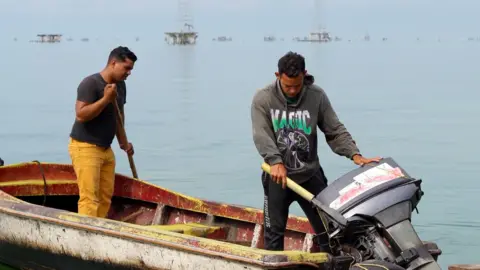
Carlos Rodríguez (right) says he would welcome US investment and the jobs it could create for his children
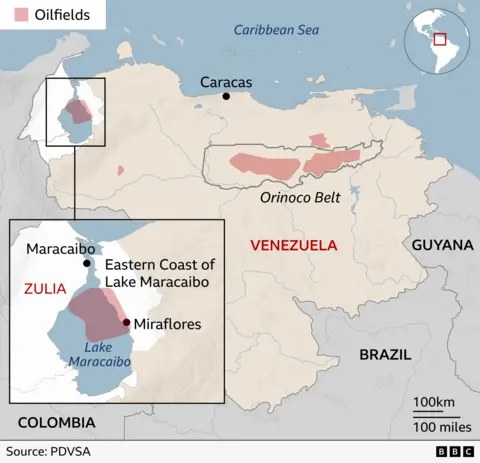
With its neat rows of detached family homes, complete with grass lawns and porches, Miraflores could be mistaken for a typical American suburb.
Located in the heartland of Venezuela's oil industry, on the Costa Oriental (Eastern Coast) of Venezuela's Lake Maracaibo, this quiet neighbourhood once helped to make the country one of the wealthiest in Latin America. It was a symbol of national prosperity.
This used to be one of the world's most productive oil basins, and along with the city of Maracaibo, across the lake, is seen as key to President Donald Trump's plan to get US firms to invest $100bn (£75bn) to rebuild Venezuela's energy industry. The country has the world's largest proven oil reserves, estimated at about 303 billion barrels.
But for now, the area around Lake Maracaibo stands as a stark reminder of how much the country's fortunes have declined over the decades.
There are oil pumps and rigs dotted everywhere - on street corners, in surrounding fields and rising out of the lake. While a handful have been freshly painted in the yellow, blue and red of the national flag and remain operational, many others have not moved in years and are rusting and falling apart.
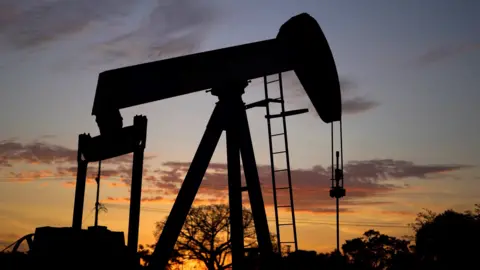
Oil pumps are a common sight in between homes and on corners of residential streets
The decay is striking in the 20 or so American-style "oil camps" on the fringes of the lake - these were originally built by international companies to house their workforce, after the commercial exploitation of Venezuela's oil reserves took off in the 1920s.
Oil giants such as Standard Oil of New Jersey (which later became Exxon), Chevron and Shell invested heavily in Maracaibo, Venezuela's second-largest city. Oil money turned former fishing villages into affluent communities with hospitals, schools, and social clubs.
In Miraflores, which housed the industry's top executives, many homes now sit abandoned and looted, their windows smashed and wiring stripped bare.
Gladysmila Gil moved to a more modest neighbourhood nearby in 1968 with her late husband, who worked in the oil industry and had the home given to him.
"When we moved into this house, it was in good condition," she recalls, sitting on a frayed chair and looking at the pink paint peeling off the walls.
"If we were sick, we went to the hospital and they treated us. The rubbish was collected every other day, and we didn't have these power outages," she adds of the economic decline Venezuela has experienced over the past 13 years.
Now rubbish is only collected sporadically and despite the oil reserves, the region has been hit by a severe energy crisis over the past decade with blackouts reported almost daily.

Gladysmila Gil says there is a huge contrast between her neighbourhood now and when she moved in nearly 60 years ago
An unfinished light rail system mired in corruption allegations, a run-down central hospital which patients have described as "hell" and deepening inequality make it feel like a microcosm of the country. Venezuela's gross domestic product (GDP) has declined by more than 70% since Nicolás Maduro became president in 2013.
"You don't see kids in these streets, there is no youth. I used to live here with nine relatives, and they all left," says 64-year-old José Gregorio Martínez, the son of a former oil worker, sitting on his front porch.
Fighting back tears, the retired teacher explains that he only survives thanks to the money his relatives send from abroad. His monthly state pension of $2.80 (£2) does not even cover his most basic needs.
Gil and Martínez recall what they see as the golden days, and are not alone in hoping that new investment from US companies will transform their lives.
In the 1970s, Venezuela pumped as much as 3.5 million barrels of oil per day - accounting for more than 7% of total global output.
Then, production was managed by a network of foreign firms, many from the US, operating under government concessions, until the industry was nationalised in 1976 and taken over by the state-owned giant, PDVSA.
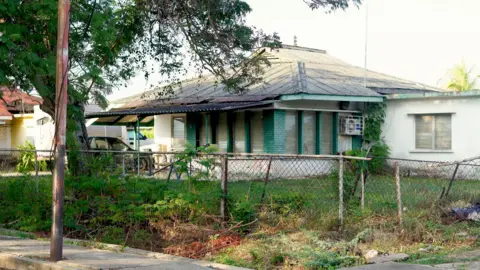
A typical house in an "oil camp" built for industry workers
The industry continued to form the backbone of the country's economy, benefiting from the high oil prices of the 1970s. When oil prices fell in the 1980s and Venezuela ran into an economic crisis, reality hit. There were protests as the government introduced austerity measures to try to balance the books.
In the 1990s, reforms were introduced to open doors to foreign investment and in 1999 the country still produced about 3.2 million barrels of oil per day, with approximately half of that output coming from Zulia state, the region around Lake Maracaibo.
Then came the rise of Chavismo - an anti-American, nationalist ideology created by Maduro's predecessor Hugo Chávez.
He became president in 1999 as oil prices were on the rise again, enabling his government to fund huge social programmes designed to lift millions out of poverty.
But by the end of 2025, oil output had fallen to about 860,000 barrels per day, less than 1% of global crude production.
Many cite 2002 as a turning point for the industry, when a strike by oil workers against Chávez's government was followed by a sweeping overhaul of PDVSA. It is widely reported that up to 22,000 people were fired.
"You can't lose 22,000 technical people in a company and expect that nothing happens," says Jorge, not his real name, who was dismissed at the time. He says the shake-up aimed to align the company with political priorities and that much of the experienced management resisted, ultimately losing their jobs.
In 2007, the oil sector was transformed again when President Chávez's government seized control of the industry.
Some foreign firms remained under new state-led partnerships, while others - most notably ExxonMobil - left the country, and the industry's decline accelerated.
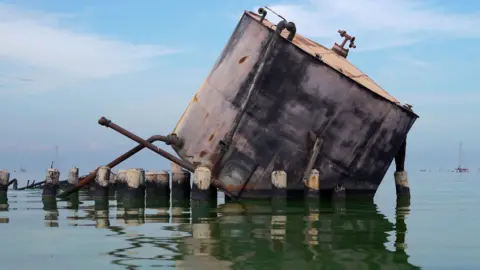
Much of the old oil infrastructure in and around Lake Maracaibo has fallen into disrepair
Mismanagement and corruption have been a problem for the sector, but the government has pointed the finger firmly at US sanctions as a major cause of the decline.
Broad economic sanctions were put in place in 2017 during Trump's first term, in response to what it called "serious abuses of human rights… establishment of an illegitimate Constituent Assembly, which has usurped the power of the democratically elected National Assembly… rampant public corruption" and "persecution of, and violence toward, the political opposition".
The turning point for the US came in early January this year when its military seized Nicolás Maduro from his compound in Caracas and took him to New York to face narco-terrorism charges - accusations he denies.
President Donald Trump said the US would "run" Venezuela and control the sale of its sanctioned oil "indefinitely", but a Maduro loyalist - Delcy Rodríguez - has since taken control of Venezuela's armed forces and the country's institutions.
While defiantly demanding the release of Maduro, who she says has been "kidnapped", Rodríguez has co-operated with the Trump administration to reform the law to allow foreign and local oil companies to operate oilfields again, through a new contract model.
Many in Maracaibo are optimistic about potential US investment.
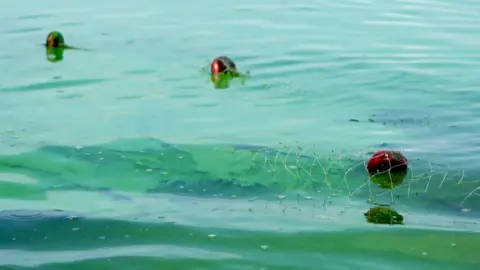
Streaks of oil can be seen in the water of Lake Maracaibo
"It would be better because then there would be work, and our children wouldn't have to resort to fishing. They could have a future instead," says Carlos Rodríguez. Now in his late 20s, he has worked these waters since he was a teenager.
As he pulls his oil-stained boat out on to the lake, the view is striking. The beauty of the sky contrasts sharply with the water, sometimes blue, but often a murky green from cyanobacteria or stained black. It's easy to see the oil slicking the surface and when I dip my hand in, it comes out streaked with oil.
"It's getting worse every day. Green, black, oily," Rodríguez complains. "And there are fewer fish." That morning, he didn't catch a single one.
He hopes that if international oil companies return, they will help clean the lake.
Others are wary. "We have no problem with [foreign companies] coming to exploit our resources, to drill wells and to create jobs," says another fisherman, José Luzardo. "But we don't want to be anyone's colony."
He is a staunch Maduro loyalist, but admits that both his family and colleagues are struggling.
Trump "can come, but he has to pay us for the oil… the oil belongs to Venezuela, it belongs to all Venezuelans", he says as he prepares to set sail.
Many others - in particular people who oppose the government - avoid speaking about politics for fear of repercussions.
Later, the sound of the lake's waves lapping against the side of Luzardo's house competes with the sizzle of hot oil. In a kitchen with bare, unplastered walls, a group of women fry the few fish caught that morning. Luzardo says they were lucky. Sometimes they come back home with nothing at all. On those days, they go to bed hungry.
Both the government and the opposition agree on the need for investment.
Juan Romero, a member of parliament representing Zulia and a local leader of the ruling PSUV party, says it is the key to the industry's revival.
"In Lake Maracaibo, there are approximately 13,000 wells that could be recovered, and there are reserves of 26 billion barrels of oil," he says.
With US sanctions removed, he believes the "economic strangulation" of the sector will end and that Venezuela will be able to attract foreign money.
But analysts warn it could take a decade and hundreds of billions of dollars to restore the nation's former output, and industry giants remain cautious. ExxonMobil's chief executive, Darren Woods, labelled the nation "uninvestable" in its current state.
Speaking at a White House summit following the removal of Maduro, he pointed out that the company had had its assets seized there twice "so you can imagine to re-enter a third time would require some pretty significant changes". Without a new legal framework and stronger protections for investors, he warned that the billions of dollars required for redevelopment would not materialise.
Yet for many in Maracaibo, hope remains that investment and prosperity will return.
Among them is 93-year-old José Rodas, a retired oil worker who still owns a special-edition Dodge Dart, a classic American muscle car that he bought during the 1970s oil boom.
"Things have become more difficult," he says. "In the past, life was easier. We had comforts then."
He points to the "commissariat", a central department within the oil camps that not only provided subsidised food but also maintained the workers' homes, with fresh coats of paint and new light bulbs.
Today, the car sitting on his neglected porch feels like a faded relic of that former life.




 English (US) ·