
 1 hour ago
4
1 hour ago
4
ARTICLE AD BOX
Sally NabilCairo correspondent, BBC Arabic

 BBC
BBC
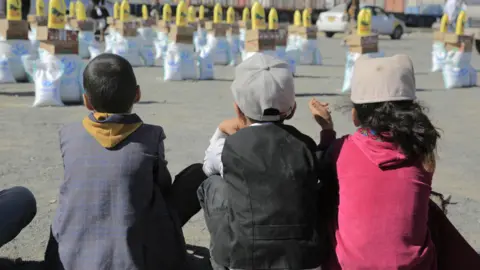
Yemen is experiencing one of the world's worst humanitarian crises
Amina has been fighting to keep alive what's left of her humanitarian lifeline in Yemen. She feels heartbroken to see the aid group she founded years ago falling apart.
"I remember how 1,600 poor families were deprived of cash because the Houthis insisted on getting a share of the money," she says.
Like many other local and international non-governmental organisations (NGOs), Amina's operations have been highly restricted by the Iran-backed Houthi movement, the de-facto rulers of north-western Yemen.
Amina says her NGO, which we are not identifying for security reasons, usually performs thorough checks on beneficiaries before handing out aid. "The Houthis wanted to give cash to 300 families of their own selection," she says.
She asked the Houthis to put their request to the international donor, as she could not justify giving financial packages to families she knew nothing about. Ultimately, she says, the initiative failed and none of the 1600 families got any money.
The impoverished country has been embroiled in a civil war since 2015, which has resulted in more than 377,000 deaths and caused one of the world's worst humanitarian disasters, with more than 22 million people requiring assistance, according to the UN.
This past year has proven to be exceptionally challenging.
Amina, whose name has been changed for her safety, says her NGO has lost 90% of its funding and has had to lay off most of its 450 staff.
She recalls one incident when eight people died in a camp for displaced families that her organisation was trying to reach.
"Women's living conditions were unimaginable. We wanted to provide clothes and hygiene kits," she says. However, the Houthis denied access, citing security concerns, she adds.
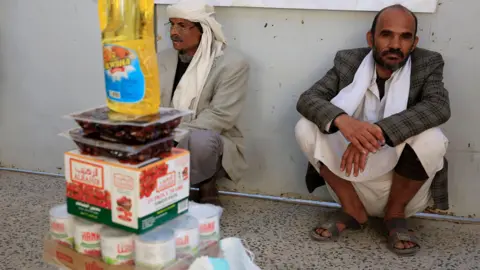
More than 22 million people in Yemen require assistance, according to the UN
Before scaling back her NGO's operation, Amina engaged in lengthy talks with the Houthis to keep it afloat. She bitterly remembers how she had to cancel a UN-funded project directed at women after the Houthis refused to grant her work permits before the deadline passed.
"They insisted we assign one of their own companies to carry out the agricultural project, otherwise we wouldn't be able to work," she explains.
Other local and international NGOs tell a similar story.
Since the Houthis - also known as Ansar Allah - seized control of the capital, Sanaa, from the government in 2014, then extended their grip over northern and western areas, humanitarian workers have been closely monitored and sometimes harassed.
NGOs have complained about their staff being detained, assets confiscated, work permits delayed, and their work dictated by the Houthis' agenda.
They have also seen sharp cuts in funding from US donors since the Trump administration designated the Houthis as a terrorist organisation in early 2025.
"It became impossible to operate, because any NGO operation that involved any material support to Ansar Allah became illegal," says an official at an international NGO, who requested anonymity.
She says many local financial institutions were also sanctioned by the US, so "the whole banking system became unstable, it was more difficult to access our money, and the international community became very careful about raising funds to Yemen".
After losing the US donations, "more than 50% of our funding portfolio for Yemen went away", leading to a complete halt of operations in northern Yemen, she adds.
She also says that leaving the north was not easy for her colleagues.
On their way out, all the NGO's assets, equipment, financial and human resources documents were confiscated by Houthi authorities, she recalls.
"While handing over our facilities to the landlords, the authorities came and tried to break down doors, then seized everything - generators, servers, computers."
Their requests to transfer archives and databases were denied, and if they want to resume their activities in Sanaa at any point, they will have to start "from square zero".
Two international aid groups, Save the Children and International Rescue Committee, suspended their work in Houthi-controlled areas last year.
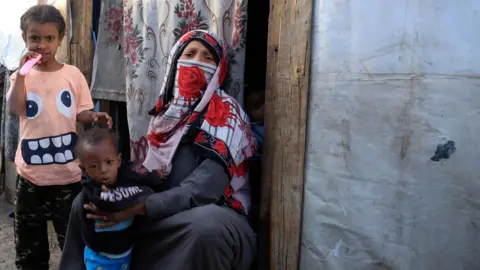
Foreign donors have diminished since the Trump administration designated the Houthis as terrorists
A UN official says the World Food Programme (WFP), which provided assistance to eight million people in Yemen in 2024, will terminate its decades-long operations in the country's north by the end of March.
That is despite the WFP warning that the already critical acute food security situation was expected to deteriorate further this year, with pockets of the population projected to face catastrophic levels of hunger in three Houthi-controlled provinces.
Amina's tone shifts to clear anger as she accuses international donors of leaving local NGOs to face Houthi authorities alone and take all the risks.
Talking to people inside Yemen has never been easy. Officials from the WFP, Save the Children, and other NGOs we contacted refused to go on the record, fearing Houthi retribution.
Many international NGOs have local staff detained in Houthi prisons.
The UN says 73 of its staff "remain arbitrarily detained" by the Houthis, with some of these detentions going back to 2021.
"These detentions of humanitarian workers are having a profound impact on operations," the UN's humanitarian chief, Tom Fletcher, reiterated this month.
Saber, a former Save the Children staff member, fled a Houthi-controlled Yemen and is now based in the government-controlled south.
Saber, not his real name, says he was gripped by fear after a colleague, Hisham al-Hakimi, died while in Houthi detention in October 2023. The father-of-four had been held without charge for more than a month.
A WFP staff member also died in detention in February 2025.
Amina says some of her staff were locked up for a few days more than five years ago. It came after they handed out financial aid packages to families based on their own needs assessment, overlooking a list of beneficiaries provided by the Houthis.
"I had to halt the operation, in this northern province, in order to secure the release of my colleagues," she says, adding that several of them were only able to return to work after receiving psychological support for a year.
The Houthis have accused detained humanitarian workers of being spies.
Last October, the group's leader, Abdul Malik al-Houthi, said in a speech that his group had arrested what he described as "well trained spy cells operating under a humanitarian cover", from organisations including the WFP and Unicef, the UN's childrens agency. The UN has rejected the allegations.
Lawyers defending the humanitarian staff have also been rounded up.
 EPA
EPA
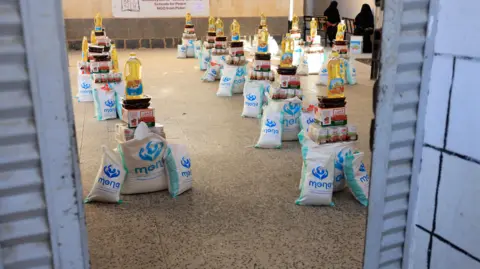
Amina said staff were detained for failing to distribute aid according to a Houthi-provided list
The BBC has repeatedly tried to contact Houthi officials for a response to the accounts we gathered but has not received a reply.
Oxfam, which has also seen some of its staff detained by the Houthis, is calling for enhanced global action to address the "dire and rapidly deteriorating" humanitarian needs in the north.
"Greater and sustained international support is urgently needed now to prevent the situation from worsening into an even more catastrophic crisis," says its Yemen country director, Farran Puig.
For locals like Amina, the future looks bleak.
She says the chances of survival for "the independent humanitarian community, as we know it in northern Yemen" are only getting slimmer.





 English (US) ·