
 7 hours ago
4
7 hours ago
4
ARTICLE AD BOX
Khanyisile NgcoboJohannesburg

 AFP/Getty Images
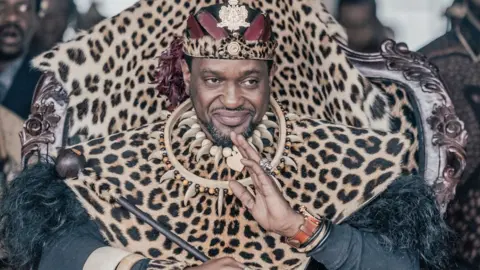
South Africa's Zulu king has raised eyebrows by using a highly derogatory term for foreigners and saying they must all leave the country during a much-hyped speech that was supposed to have been aimed at calming anti-migrant feelings in his home province of KwaZulu-Natal.
Warning: This story contains language some people may find offensive
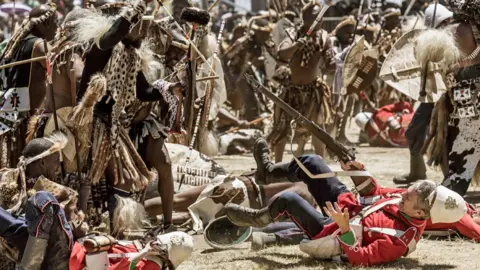
Misuzulu kaZwelithini was addressing his supporters at the place where 20,000 Zulus warriors defeated a British contingent of 1,800 soldiers 147 years ago beneath the rocky outcrop of Isandlwana hill.
The Battle of Isandlwana, fought during the Anglo-Zulu war, is something many Zulus wear like a badge of honour: they fought against a foreign army and won - the foreigners were cowed.
The ire of many of King Misuzulu's subjects is now directed not at British invaders but at migrants from neighbouring countries like Lesotho, Mozambique and Zimbabwe who have come to South Africa to work. According to official statistics, the country is home to about 2.4 million migrants, about 4% of the population.
The 51-year-old monarch did not advocate violence but said all "kwerekwere", an offensive word for African migrants, must pack their bags - even if they were in relationships with South Africans and had children with them.
"We must now sit down and discuss this because even if my nephew's father is a 'kwerekwere', the 'kwerekwere' must leave, only the child will remain," he said on Thursday to the delight of his audience - a response which prompted him to burst out laughing.
 AFP/Getty Images
Events marking the Battle of Isandlwana usually include a re-enactment of the Zulu victory, like this one from 2023
Many online have been quick to point out the irony of his remarks, considering the king's own mother was from Eswatini and one of his wives is also from the neighbouring kingdom.
But such xenophobic attitudes have long been an issue in South Africa, leading to deadly outbreaks of violence - and his comments echo those made by his late father Goodwill Zwelithini, who urged migrants in 2015 to "pack their belongings".
He later tried to back-pedal, claiming he was misquoted, but the country's human rights body found his comments "hurtful and harmful".
More than a decade on, xenophobia and anger directed at migrants remain a key political issue - with some believing foreigners are stealing jobs and benefiting from public services meant for South Africans.
The rate of unemployment in the country remains one of the highest in the world at around 33%.
This is something new opposition parties - like uMkhonto weSizwe (MK) led by former President Jacob Zuma, whose main support base is in KwaZulu-Natal - have latched on to with populist policies that support the expulsion of undocumented migrants.
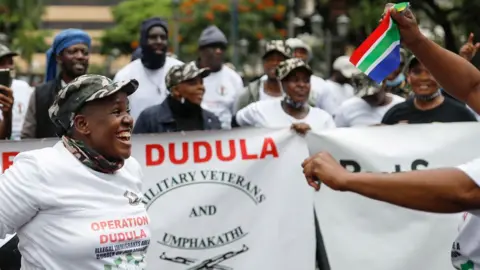
This has led in recent years to the rise of vigilante anti-migrant groups, like Operation Dudula and March on March, which have gained notoriety for their demands that foreign nationals be removed from the country. "Dudula" means "to remove something by force" in the Zulu language.
Their latest campaign took place a few days before the king's speech and not long after the start of the academic year.
An angry group of protesters descended on a primary school in the KwaZulu-Natal port city of Durban, claiming that 90% of the pupils there were the children of migrants.
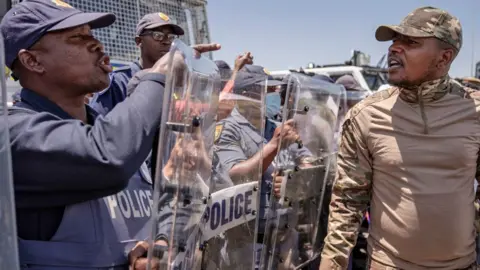
The heated demonstration forced the school to call parents to come and collect the students because of safety concerns - and the next day a large contingent of police was deployed to the gates of Addington Primary School.
The local authorities hit out at the organisers of the march, which was also supported by MK, and accused them of spreading misinformation.
This prompted the education department to reveal that nationally, 253,618 foreign pupils are enrolled in South Africa's public schools - 1.8% of all students. Of these, 14,929 are at public schools in KwaZulu-Natal.
Commentators have also pointed out that in South Africa, all children have a legal right to basic education, irrespective of their nationality or status in the country.
 AFP/Getty Images
Dudula means "to remove something by force" in the Zulu language
Following the Addington Primary School protests and ahead of the Battle of Isandlwana commemoration, royal envoys hinted that King Misuzulu would address these concerns.
He has no formal political power, but a fifth of South Africa's population is Zulu and the monarchy remains hugely influential with a large budget funded by taxpayers.
The king also oversees a trust that owns and controls vast tracts of communal land in KwaZulu-Natal, which is supposed to be for the benefit local communities.
"We will speak to the 'kwerekweres' and tell them to leave. There is nobody who does not have a home to return to," the king said.
For Dr Vusumusi Sibanda, a human rights lawyer and expert on African diaspora issues, such words are "unfortunate" and "worrying" and encourage ordinary citizens to take the law into their own hands.
"The king is respected by [many people], including foreigners, and he's supposed to be that symbol," he told the BBC.
Lizette Lancaster, who works at South Africa's Institute for Security Studies think-tank, echoes this, telling me that the king's comments only served to "fuel anti-migrant sentiment and should be strongly condemned".
She also weighed in on the actions of vigilante groups, saying that while South African law protected activism, orchestrating vigilante activity "including incitement or actions against migrants, must be identified and dealt with".
The leader of March on March, Jacinta Ngobese Zuma, is now facing a public violence charge over the protests at Addington Primary School.
 AFP/Getty Images
In November, a court ordered Operation Dudula to stop blocking foreign nationals from accessing public health facilities and schools
Another topic raised by the king that has the nation talking is his call to drop "Natal" from KwaZulu-Natal's name - again echoing a wish of his father.
"We need to remove this 'Natal'. This is KwaZulu, so I don't understand why we have this Natal," the king said.
Prior to 1994 and the end of South Africa's racist system of apartheid, the province now known as KwaZulu-Natal was split into two.
KwaZulu was classified as a "homeland", a semi-autonomous area reserved for ethnic Zulus, which existed within Natal province.
When South Africa ushered in democratic rule with Nelson Mandela elected president, the two were merged and the name conjoined.
Over the last three decades, many cities, towns and roads in South Africa have been renamed, replacing them with indigenous ones or calling them after heroes of the struggle against apartheid.
But for some commentators, the call to name the province simply KwaZulu is an unpalatable reminder of Zulu nationalism and its potential dangers.
In the years after Mandela's release from prison in 1990, political violence between his supporters and those of a Zulu nationalist party nearly derailed the process that led to the end of white-minority rule.
There are fears that renaming KwaZulu-Natal would create a kind of exceptionalism that could lead to more trouble in the ethnically diverse country which has 11 official languages.
Cultural expert Prof Musa Xulu is also quick to add that it would be wrong to regard KwaZulu-Natal as a Zulu province.
"In reality, it's a multicultural province," he told the BBC.
"[Re]naming it KwaZulu would be a distortion of history. There was never a time in history when this whole region… was a kingdom of the Zulus," he said.
Zulus "don't have the powers to simply push people around and say that the province should be known as KwaZulu", the academic added.
Until now King Misuzulu, on the throne since 2022, has mainly made the headlines with regard to the royal succession battle and his controversial divorce.
But now he seems to be following in his father's footsteps - and picking at scabs that never get a chance to heal in what is a politically charged environment.
You may also be interested in:
 Getty Images/BBC




 English (US) ·