
 2 hours ago
7
2 hours ago
7
ARTICLE AD BOX
Anthony ZurcherNorth America correspondent

 Getty Images
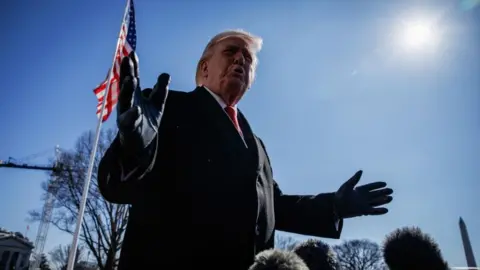
Donald Trump had been warning for months that a Supreme Court decision like this would be catastrophic.
If the court curtailed his ability to impose these tariffs, he had said, it would be an "economic and national security disaster".
A six-justice majority of the Supreme Court, in ruling against the president on Friday, didn't care much about his concerns.
Congress, not the president, has the power to impose tariffs, the justices ruled. And nothing in the law that the president based his tariffs on, the Emergency Economic Powers Act of 1977, delegated such sweeping powers to Trump.
The court's decision represents a rare check on this president's broad use of executive authority.
A majority of the justices over the past year have shown a willingness to allow Trump to press ahead with his agenda, particularly on immigration and reshaping the federal government, even as legal challenges work their way through the court system.
This case, considered on an expedited basis, slams the door on one such expansive use of presidential authority.
With several other major cases involving controversial uses of executive power, such as efforts to end birthright citizenship and to dismiss a Federal Reserve governor based on alleged improprieties, this may not be Trump's only setback in the coming months.
At the very least, this decision weakens Trump's hand when trying to force other nations to make concessions to the US and tarnishes his veneer of invincibility.
Weakness begets weakness, and America's trading partners may be emboldened to take a tougher line with the US now that the president's tariff powers have been curtailed.
It also opens up the possibility that the Trump administration may have to give back much of the tariff revenue it collected over the past year.
While the justices left this thorny issue to be decided by a lower court, Brett Kavanaugh in his dissent warned that the process is likely to be a "mess".
The Trump administration had plenty of time to prepare for Friday's decision.
Supreme Court precedent, and the attitude of many of the justices when the case was argued in court last November, indicated that an adverse outcome for the president was quite possible.
Jamieson Greer, Trump's top trade adviser, said last month that the White House has "a lot of different options" on how to proceed if the tariffs were struck down.
"The reality," he said, "is the president is going to have tariffs as part of his trade policy going forward."
The other options that could be at Trump's disposal are more limited, however.
They require more factual determinations to impose tariffs and have limits on their scope and duration. Gone are the days when the president could threaten, or enact, triple-digit tariffs with the wave of a pen or the click of a Truth Social post.
 Getty Images
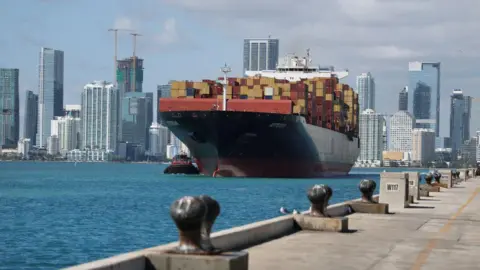
A Rotterdam container ship prepares to dock at Port Miami
New tariffs will require a longer lead-in time before they are imposed.
That could limit the kind of economic disruption that took place when the president announced his expansive Liberation Day" tariffs last year, and would give other nations more time to prepare their responses.
If Trump wants to restore his free hand to impose new tariffs, he could always ask Congress for the kind of explicit authorisation that the Supreme Court has said is necessary. But with narrow Republican majorities in the House and Senate, and midterm elections looming, the success of such a move seems unlikely.
In fact, some of Trump's conservative allies in Congress may be breathing somewhat easier with this decision.
The president's tariffs - and the costs they have imposed on consumers - have been unpopular among many Americans. Republican candidates in battleground states and congressional districts would have been open to Democratic attacks for supporting Trump's policies.
That area of vulnerability has been reduced for now.
Friday's decision will set up an awkward moment on Tuesday, when Trump delivers his annual State of the Union Address to a joint session of Congress. Traditionally, many of the Supreme Court justices sit in the front row of the chamber.
The president, after spending months issuing dire warnings against the court, could stand eye-to-eye with the justices who eroded one of the key pillars of Trump's second-term agenda.







 English (US) ·