
 2 hours ago
7
2 hours ago
7
ARTICLE AD BOX
Faren TaghizadehBBC Persian

 EPA
EPA
"The number of explosions, the destruction, what is happening - it's unbelievable," says Salar, whose name has been changed.
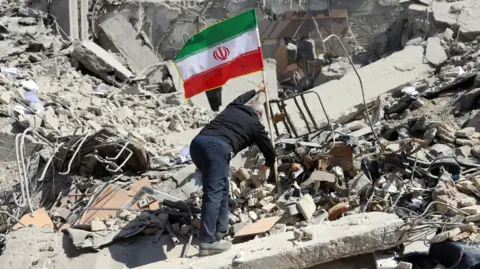
Iran's capital, Tehran, is under heavy attack since strikes began on 28 February, as the US and Israel target military and political sites in a bid to weaken the Islamic regime.
However, other areas have been hit as a consequence of the strikes. Iranian officials said more than 160 people, including children, were killed when a girls' school was hit in the city of Minab on Saturday. The White House says the US is investigating the incident but does not target civilians.
While some Iranians say the ongoing attacks have left them fearing for their families, others characterise the regime as fearful and express hope for the country's future.
"Each day has felt like a month," Salar says. "The volume of attacks is so high."
He said a recent air strike left his whole house shaking and described having to leave his windows opens so the glass wouldn't shatter.
International news organisations are often refused visas to Iran, which severely limits their ability to gather information about what is going on inside the country. Internet blackouts make the situation even harder.
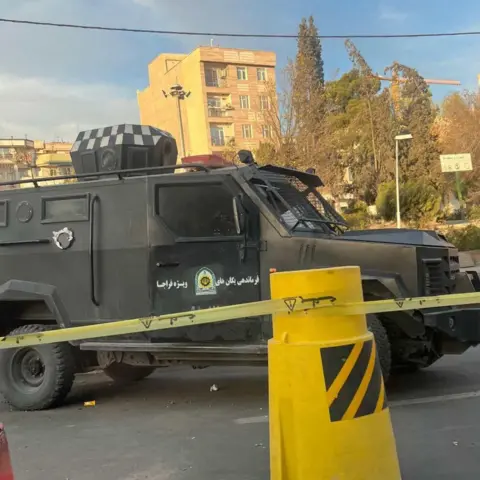
"There are checkpoints everywhere. They're scared of their own shadows," says one 25-year old student in Tehran.
"We're waiting for the grand moment, the final moment, when we all go out and we will be victorious."
The price of staples like eggs and potatoes have also skyrocketed, he said, and the queues for petrol and bread "are unbelievable".
Another resident of the capital tells the BBC that most shops are closed and some cash machines out of service, though supermarkets and bakeries remain open.
Tehran feels "empty" and anyone leaving their home must have an "urgent reason", she says.
"On the first day, people were chanting and everyone seemed happy. But now there are police forces around."
Salar described threats from security forces about speaking out against the country's regime.
While getting access to independent information has been hard, Salar says Iranian security forces have been making their demands clear.
"Every day they send SMS messages warning that if we go outside, they will deal with us harshly," he says.
"A message came saying that if anyone among you goes out and protests 'we consider you Israeli collaborators'."
He believes the tone of the message suggested that anyone who disobeyed would be dealt with forcefully, or even killed.
 Getty Images
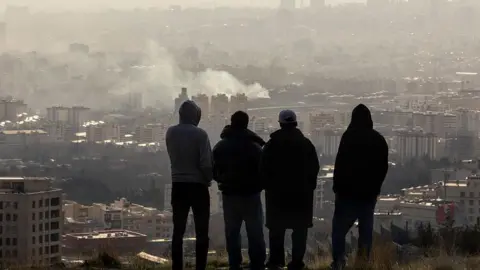
Tehran has been under near-constant bombardment since Saturday
BBC Persian also spoke to Kaveh, whose name has also been changed, who lives in Zanjan, a city around 275km (170 miles) north-east of Tehran, which has also been targeted.
"In the first three days, our city was heavily bombed," he says. "We live in an area where fighter jets constantly pass overhead."
He adds that, following the outbreak of war, the sky had been constantly cloudy from the columns of smoke rising from the sites of air strikes - an image he describes as "simultaneously beautiful and horrifying".
Salar says he sent his parents north, though he wasn't sure which cities would be safe. There house is in the Shariati neighbourhood of Tehran, where there are many military facilities that have been targeted.
"My mother was in very bad shape - she was very frightened," he says, adding that the current strikes are worse than any she experienced during the eight-year Iran-Iraq war in the 1980s.
More people continue to leave Tehran as each day passes, he adds, but it is not an option for everyone.
"My friend's grandmother is ill and they can't move her."
The internet blackouts have also made it extremely difficult for Iranians to contact their loved ones.
Kaveh says that, alongside survival, his biggest concerns have been trying to maintain some contact with family and friends, and getting access to reliable news.
His internet connection cut off around midday on the first day of the attacks, he recalls, and he was not able to get back online for two days.
Both Kaveh and Salar are using Virtual Private Networks (VPNs), which allow them to access internet sites that are blocked by the Iranian government, but this is no easy feat.
When he does get online, Kaveh tries to help "friends outside Iran who have no news from their families - to get updates or pass along messages".
 supplied
The regime appears to have increased its security presence on the streets of Tehran
Due to the tight security situation in Iran, it is not possible to gauge the overall reaction to death of the supreme leader.
While some took to the streets to celebrate, others took part in public displays of mourning led by government authorities.
Kaveh found the news of Khamenei's killing difficult to believe at first.
"I had always imagined that moment would feel like happiness, but it didn't," he says.
"Almost all the years of my life and the lives of millions like me were destroyed and thousands lost their lives - and yet he himself was removed from the scene in a single moment, [which] made me truly angry."
Saleh says he didn't expect the celebrations on the street to news of the supreme leader's death.
"The city atmosphere after the attack was very security-heavy. It still is."
Neither of the men know what the war will mean for them, their families or their country.
"I doubt any of us will ever be the same as before," Salar says, adding that many people are severely stressed.
"Those abroad, especially monarchists," he says - referring to the supporters of the son of Iran's former royal family who have supported the US and Israeli military action - "really don't know what we are experiencing".
He adds: "I hope they never have to."
Kaveh says he feels the war "won't end as quickly as we thought".
"But even so, my hope hasn't decreased. If anything, it grows stronger each day."
"I don't know what will happen after this 'operation'," he says, but adds that, without it, "something worse would definitely have happened".
"This way, at least there is still a chance for life and for tomorrow."
Additional reporting by Alex Boyd, Ghoncheh Habibiazad, Caroline Hawley and Tom McArthur





 English (US) ·