
 3 hours ago
8
3 hours ago
8
ARTICLE AD BOX
Vanessa BuschschlüterLatin America editor, BBC News Online

 Reuters
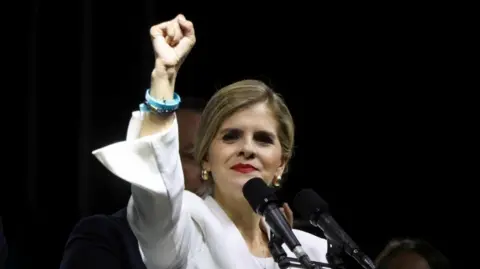
Laura Fernández sailed to victory in the first round with no need for a run-off
The candidate for the governing conservative Sovereign People's Party, Laura Fernández, has won the presidential election in Costa Rica.
With more than 88% of the votes counted, Fernández had over 48% of the votes, far ahead of the second-placed centrist candidate, Álvaro Ramos, who conceded defeat.
Fernández ran on a promise to deepen the tough-on-crime approach of the outgoing President, Rodrigo Chaves, who had handpicked her as his successor.
Voters had said they were concerned about a surge in drug-related violence in the Central American country.
The size of her vote share - which exceeded the 40% needed to win outright in the first round - means that there is no need for a run-off.
Fernández will be sworn in to office on 8 May.
In her victory speech, the 39-year-old said she would plough ahead with the policies introduced by Chaves, whose chief of staff she was.
Under Costa Rica's constitution, presidents are not allowed to serve two consecutive terms and Chaves was therefore barred from standing for re-election.
Fernández has hinted she may appoint him to a post in cabinet.
Costa Rica, one of Central America's safest countries and a stable democracy, has seen a rise in crime over the past years as transnational criminal gangs have expanded in the region.
On the campaign trail, Fernández said she would emulate some of the policies of the President of El Salvador, Nayib Bukele.
Bukele has sky-high approval ratings with Salvadoreans saying they are grateful for his iron-fist approach to crime, which has seen the murder rate plummet.
Fernández has said she will declare a state of emergency in areas where gangs hold sway and finish the construction of a high-security jail similar to the Cecot prison in El Salvador.
Addressing concerns by her critics that her policies could erode the rights of citizens, Fernández declared in her victory speech that her government would be one of "dialogue and national harmony, respectful and firmly based in the rule of law".
She did however strike a combative note too, criticising the opposition for its "obstruction and sabotage" in a reference to the challenges Chaves faced getting some of his policies approved in parliament, which was dominated by opposition lawmakers.
With her party winning 30 out of the 57 seats in parliament, Fernández is expected to have more backing in the legislature than her predecessor in office.
 Reuters
Before running for the presidency, the 39-year-old served as planning minister as well as in other posts.
But above all, she is seen as the heir to Chaves, whose direct and sometimes confrontational style she shares.
She is also expected to maintain the close ties her predecessor built with the US.
Chaves signed a "safe third-country migrant agreement" with America, which means the Trump administration can deport migrants from countries other than Costa Rica to the Central American nation.
The agreement allows the US to remove migrants from countries deemed unsafe to a third country considered safe.
The Trump administration has described Costa Rica as a "key global cocaine transshipment point" adding that is has "become an increasingly significant waypoint for criminal organisations trafficking cocaine" to the US.
Fernández has said she would be would be willing to declare a state of emergency - and lift some of citizens' rights - if organised crime where to further take hold in certain areas.
She will become the second woman to govern the Central American nation after Laura Chinchilla, who was elected president in 2010.






 English (US) ·